No Results Found
The page you requested could not be found. Try refining your search, or use the navigation above to locate the post.


The Vršič mountain pass itself is described in detail in the blog “To Vršič by bike – click here to see it“, so this time we will focus on those who will be walking instead of cycling or driving. The trail itself is not difficult and in this season, apart from good footwear, we only recommend that you throw an umbrella or a thin raincoat in your backpack along with enough drinks, as sudden storms are quite common in this area. Winter is different, as the altitude means that the pass is always covered in snow and often not completely removed due to the risk of avalanches. In this case, suitable and warm clothing, good footwear, and at least a pair of crampons are almost compulsory – provided, of course, that the snow is not cleaned.

Pagan Girl Up Close
From the Reset Apartments, turn left along the cycling route to Kranjska Gora. Walk through the center to the right, towards the Best Western Hotel, where you turn right onto the Vršiška road, which will take you in a few minutes to the first obligatory stop – Lake Jasna – where you turn onto the macadam path and walk around the lake on your right. You continue to the bridge over the Pišnica River, where the first challenging climb begins, lasting until the first of the 24 serpentines. You continue along the road and the many shortcuts that intersect the serpentines, shortening the distance to the top of the pass considerably. We recommend using Google navigation.
The first obligatory stop is Miha’s Lodge (1085 m). The mountain outpost, built after World War I as a Yugoslav military outpost, was converted in 1948 into a mountaineering outpost named after the Slovenian mountaineer Miha Arih, who died during World War II. The lodge is managed by PD Kranjska Gora, while the caretakers have changed over the years. In 2020, it even won the award for the best mountain lodge of 2020 in a campaign organized by Siola and the Slovenian Mountaineering Association with the votes of mountain visitors.
The lodge is known for its excellent culinary offer. They offer mountain dishes made from ingredients supplied by local suppliers. For example, Miha’s plate consists of buckwheat dumplings, pork roast, and sauerkraut, and you can also try Miha’s stew. The menu changes, but there are a few regular dishes, such as jota, štruklji, strudel, etc. The home itself has been open continuously since 1948, both in summer and winter and on weekends in the low seasons. There are 23 beds in the lodge.
The Russian Chapel (1130 m) is situated slightly higher up, about 50 m from the road, in memory of the Russian prisoners who were victims of an avalanche during the First World War. During the construction of the Vršiška road, 170 to 300 Russian and 10 to 80 Austro-Hungarian soldiers are believed to have died. Kranjska Gora was an important strategic point on the Isonzo Front at this time. The Orthodox wooden chapel of St Vladimir was built in 1916 and next to it is the grave of one of the buried soldiers with the Russian inscription “To the Sons of Russia”. The chapel is wooden and has a stone foundation. The two domes imitate the typical Russian Baroque style. You can find out more about the chapel here.
Koca na Gozdu (translates to Lodge in the Woods) (1226 m) is a mountain lodge-like Miha’s Lodge (Mihov Dom), but much larger and offers accommodation for several climbers. It is very suitable for school or kindergarten camps in nature, as well as for families and individual guests. The history of the lodge is varied, as originally a lodge named “Rimlova koča” stood there, which was built in 1916 to meet the needs of the builders of the road to Vršič mountain pass during the First World War. After the war, it was converted into a mountain lodge in 1922 but had to be closed in 1979 due to its dilapidated condition. In 1986, a new, larger, and more modern outpost was built in its place, which, like Miha’s Lodge, is managed by PD Kranjska Gora.
Since 2013, the lodge has been awarded the title of Family Friendly Lodge by the Slovenian Mountaineering Association. It has 54 beds and a large dining area for activities such as various workshops, lectures, etc.
Koča na Gozdu is known for its varied culinary offer, serving authentic homemade Slovenian dishes such as štruklji, gorenjski krapi, spoon dishes, and blueberry strudel. We particularly recommend excellently prepared game dishes such as venison roast and venison goulash.
Just above Koča na Gozdu (Lodge in the Woods), there is a viewpoint with mountain maps and a magnificent view of the most famous natural window in the Julian Alps – the Prisankovo okno (literally translates to Prisank’s Window), which is, along with the Pagan Girl, one of the other major natural landmarks in this part of the Julian Alps. The window is one of the largest natural mountain openings in Slovenia and is 80 meters high and 40 meters wide – you could fit a small skyscraper inside. It was formed as a result of a natural intrusion that grew into the current opening as it was being prepared. If you choose the right moment to visit and are a bit lucky, you might even be able to capture the moment when the sun shines through the opening of Mount Prisank.
Erjavčeva koča (1525 m) is situated on a small hill just below the top of the pass, in the safe shelter of larch trees and the walls of Mount Prisank and Mojstrovka Mountains. The original lodge was built in 1901 by the German-Austrian Mountaineering Association as a Vosshütte and was used by the builders of the road to Vršič during the First World War. It was renamed to its present name after the First World War after the Slovenian naturalist and writer Fran Erjavec. The lodge in its present form was built and opened in 1993 and is managed by PD Jesenice. The lodge is open all year round, but if the winter snow cover on the pass is more than 10 m thick, the maintenance of the lodge can be quite demanding and the risk of avalanches often cuts people off from the world.
In addition to the rich culinary offer, the lodge is also certified as a family-friendly and cyclist-friendly lodge.
At the very top of the pass is Tičarjev dom (1620 m), which is the starting point of the trail leading to the most beautiful viewpoint of the Pagan Girl. The mountain outpost has a rich and interesting history of more than a century. The first lodge on this site was built in 1912 by the Slovenian Mountaineering Association on the initiative and with the help of Dr. Josip Tičar, after whom the lodge is named. It was occupied by Austrian soldiers during the First World War and by Italian financiers during both wars. After the Second World War, the hut was renovated and reopened in 1946, and later, in 1966, a new modern building was built on the old foundations, which still stands today.
Tičarjev dom on Vršič mountain pass has 34 beds in rooms and 26 beds in dormitories. There are 93 seats in the dining room (two rooms) and 110 seats outside the lodge. The hostel has toilets, washrooms, and showers with hot and cold water in the basement and on the upper floor. The catering rooms are heated by a farmhouse stove.
As mentioned, the path to the viewpoint starts behind Erjavčeva koča. The path is wide and well maintained, but also not too steep, so it is suitable for almost everyone and offers wonderful views not only of the Pagan Girl but also of the surrounding mountains. Follow the signs and markers for the Postman’s Lodge, which is located at the end of the trail. Somewhere in the middle, you will pass the ruins of former buildings built during the First World War and reach a small hill that offers a wonderful view directly onto the face of the fairy-tale creature. The face is naturally carved into the mighty walls of Mount Prisank and the sight of it overwhelms you with its size. The legend of the Pagan Girl tells of Goldhorn, who, according to her prophecy, is shot by the son of a hunter…
The Postman’s Lodge (1688 m) is the final destination of the trip to Pagan Girl. It is located a few minutes further from the viewpoint. The lodge has 1 restaurant with 53 seats and a bar and is open only in summer… It has 10 rooms with 30 beds and 20 in dormitories. It is a starting point for hiking trails to Mojstrovka, Prisojnik, Razor, Jalovec, and other peaks of the Julian Alps.
The lodge was built in 1922 by Yugoslav border guards and used as a border guard post. In 1952, the mountaineers from Jesenice converted the lodge into a mountain lodge. The following year, the Postman’s Lodge was built on its site by the postmen-mountaineers.
Before you set off, make sure you check the weather conditions and choose the best route for your equipment and skills!


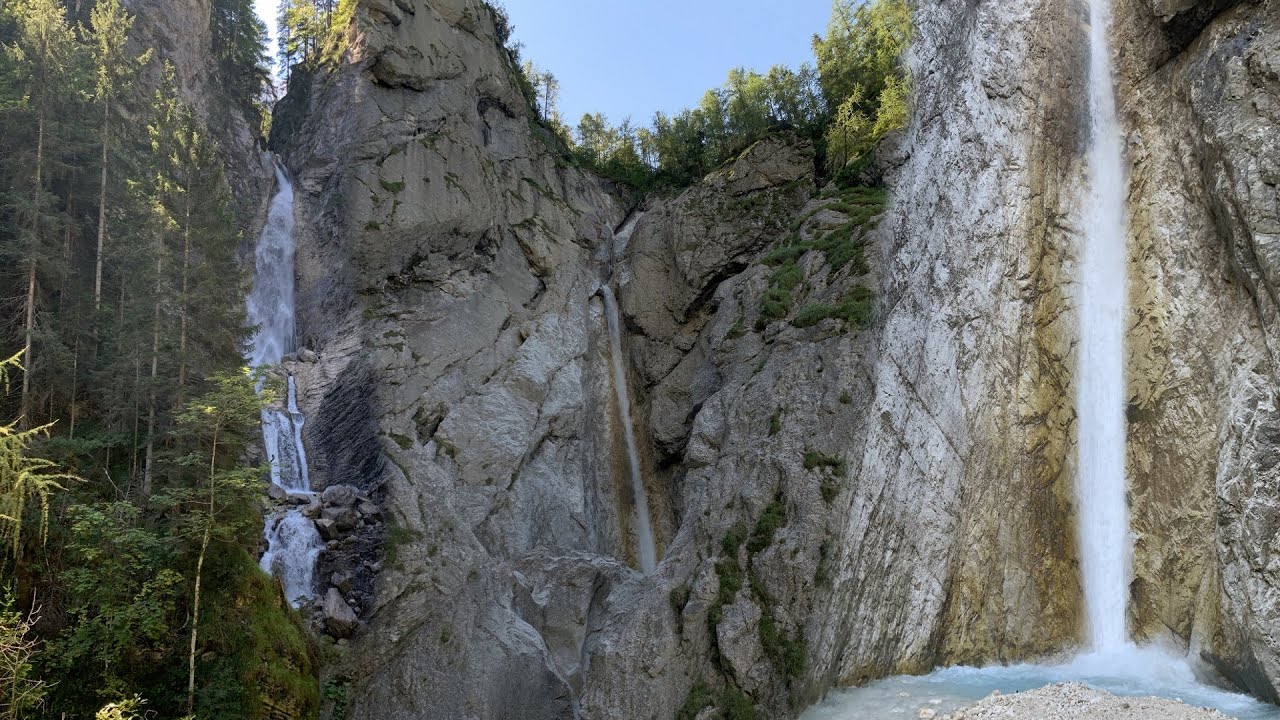
The Martuljek Waterfalls are located in the picturesque Martuljek Mountain Group, just below Špik, one of Slovenia’s most famous mountains. The waterfalls are named after the village of Martuljek, where the starting point of the tour is. The waterfalls themselves consist of two waterfalls, the Upper and the Lower Waterfall. The lower one is 50m high, while the upper one is particularly spectacular as it flows over a 110m high cliff surrounded by a white-rock amphitheatre. Both waterfalls are easily accessible and suitable for a trip with younger children, provided you stick to the well-maintained and marked trails. However, if you want to get right below the upper waterfall, you will have to climb over a difficult passage secured with ropes, which is only suitable for experienced and well-equipped hillwalkers, so we advise against this part of the trail.

Upper waterfall
The Martuljek waterfalls, fed by the Martuljek stream, are located in an area that was declared a landscape park in 1949 and became part of the Triglav National Park (TNP) in 1981. The waterfalls are most beautiful in the late spring when the snow begins to melt in the mountains above them, and in the autumn rainy days.
From the Reset Apartments (direction Ljubljana), the starting point of the tour in the village of Martuljek is an 8-minute drive away by car, or you can cycle there on the Kranjska Gora – Martuljek cycling route. You can park at the Triangel Hotel, but please note that the parking lot is often busy on weekends and during the peak tourist season. There is no entrance fee to visit the waterfalls!
From the car park, follow the asphalted cycling route straight to the forest path, which is well-signposted (you can also find it in the “Google Maps” app) and is suitable for everyone, including families with young children. The ground becomes steep near the waterfalls, so take extra care.
The path below the upper waterfall itself, to the small pool, leads through a difficult passage secured with ropes and is recommended only for properly equipped and experienced hikers.
If you want to try homemade delicacies or spoon dishes, we recommend a short stop at the log cabin “Pri Ingotu”, which is located somewhere in the middle between the first and the second waterfall.
Home-made fruit and herb juices are a specialty of the log cabin, and you can also enjoy a sip of homemade “ta kratki”, a schnapps made by the caretaker’s daughter and her husband. You can also warm up with hot tea made from the surrounding herbs, while outdoors you will be welcomed by the black kitchen, where you will witness the cooking of a stew in a cauldron over an open fire. For those with a sweet tooth, there are excellent homemade desserts.
For more information about the restaurant, click here.
You can also take a trip by bike on the D3 cycling route, which leads directly past our apartments in the direction of Ljubljana. The forest path to the waterfalls described above is not suitable for cycling, so you will need to leave your bike in Martuljek village and continue on foot towards the waterfalls. The log cabin “Pri Ingotu” can otherwise be reached by mountain bike, but there is a branch off the cycling route onto the forest path further towards Jesenice.



The walk to the two artificial lakes in Jasná is short and without any major climbs, so it is also suitable for younger children, who will be able to feed the ducks and play on the well-kept sandy beaches. The lakes are surrounded by the many peaks of the Julian Alps, which are beautifully reflected in the blue, crystal clear but cool water. Together with the bronze statue of the Goldhorn and the 6-metre wooden tower, the lakes form one of the most beautiful views in the Triglav National Park, so don’t forget to bring your camera or camera. You’ll get the best photos from the watchtower, posing next to the Goldhorn statue, or from the new, attractive suspension bridge over the Pišnica River canyon.

Suspension bridge over the river Pišnica
Originally, Jasna was an artificial bathing area with associated facilities for the selected guests of the Austro-Hungarian monarchy. The bath was enclosed by a fence and barbed wire and was closed to the public until 1945, long after the fall of the monarchy. The baths remained in use until 1966, when the bottom of the pool was ruptured by an earthquake in the Soča valley, and the torrential waters of the Pišnica River also caused considerable damage. The original pool was filled in with materials from the surrounding area, creating a larger basin that was filled with water from natural underground sources. The present attractive appearance of the site was created in 1981 with the excavation of a second lake.
The two lakes are located in the immediate vicinity of Kranjska Gora, at the confluence of the Mala and Velika Pišnica rivers, on the road to the Vršič mountain pass, and are well-visited tourist attractions as they are two of the most beautiful lakes in the entire Triglav National Park. The location also serves as a must-stop for all excursionists heading to the Vršič mountain pass or further on through Trenta valley and the picturesque Soča valley to Nova Gorica.
To reach Jasna, follow the path through the center of Kranjska Gora, where you turn left onto the road to Vršič. The road has pavement for walkers all the way to the lakes, or you can turn right onto a well-maintained path that follows the Pišnica River all the way to the bridge, next to a small hydroelectric power station. Immediately afterward, you will have a wonderful view of the lakes and the surrounding area, which is made up of the mighty mountains of the Triglav National Park.
The destination is ideal for a pleasant walk or a cycling stop. The water is not suitable for swimming as it is extremely cold, fed by melting snow and ice from the surrounding mountains.
The two lakes are small and can be circumnavigated in 10 to 15 minutes. Younger children will be able to explore the surrounding area with a small swamp filled with frog tadpoles in the spring days, and throughout the year they will be able to feed the flocks of ducks and numerous trouts in both lakes.
If you are heading to Jasna, we recommend you visit:


The page you requested could not be found. Try refining your search, or use the navigation above to locate the post.


Ski touring is becoming increasingly popular in Slovenia. There is always plenty of snow in the high mountain range, even when the ski slopes are short of it, and the ski season can be delayed almost until summer, depending on winter snow conditions. Skiing on untouched snow-covered slopes and ungroomed terrain is a special experience, but it requires a lot of skiing and mountaineering skills. If you are a mountain lover and you love skiing, ski touring is one of the most unforgettable experiences. You simply have to experience it.

The Vršič mountain pass is an extremely popular base for ski touring, as it offers easy access directly to many of the Julian Alps’ two-thousand-meter peaks.
Skiing on ungroomed but natural slopes is a combination of alpine skiing, cross-country skiing, and hiking. If you love peace and untouched nature, then perhaps ski touring is just what you need! If you want to go to the mountains in winter, you will definitely need all the necessary equipment for winter mountaineering and specially adapted ski equipment for the descent itself. Skis need to be light and have special flexible fittings for going uphill. They shall also be equipped with a special notch for attaching the skins to prevent slipping. Boots shall be light and flexible with a non-slip sole and a rough profile. You will also need telescopic poles, a helmet, first aid, and a set of avalanche protection equipment. It is particularly advisable to wear a locator beacon when ski touring in case you are caught in an avalanche.
The peace, the connection with nature, and the feeling of unlimited freedom!
Ski touring is characterized by climbing a hill without a lift, unmarked slopes, experienced skiers, and untouched snow. It must be approached with great care, with responsibility for safety, and, above all, with the right equipment. The weather forecast and the level of avalanche risk are also important factors in deciding when and where to go on a ski tour. Special uphill skis can also help you get up the hill, but where this is not possible you will need to rely on snowshoes or crampons, an ice axe, and other mountaineering equipment. Both ascending and descending, you need to be constantly on the lookout for snow-covered caves and crevasses and be alert for avalanches, which can be fatal. The best time to go ski touring is in winter or spring, depending on snow conditions and air temperature.
On more difficult terrain it is best to ski with a certified and experienced guide, especially on unfamiliar terrain. Mountain guides have expert knowledge of the terrain and weather conditions, but a good guide will also help you improve your skills on icy terrain and achieve a higher level of ski touring knowledge.
A list of compulsory equipment that you can borrow in Kranjska Gora:
There are many opportunities for unforgettable wild skiing in the Zgornjesavska Valley. There are countless trails for beginners and steep slopes for experienced skiers who want to try the most extreme ridges in the Julian Alps. The most popular ski touring trails lead from Mojstrovka, the Kot mountain pass, the ridge behind Cmiro, and Dovska Baba. Skiing from below the Kriška Wall and from Kredarica to Krma is also fun.
V Zgornjesavski dolini priložnosti za nepozabno divjo smuko ne manjka. Poti je nešteto tako, za začetnike kot strmih za izkušene smučarje, ki so željni preizkusiti najbolj ekstremne grebene v Julijskih Alpah. Najbolj priljubljene turno smučarske poti vodijo iz Mojstrovke, Kotovega sedla, grebena za Cmirom in Dovške Babe. Zabavna je tudi smuka izpod Kriške stene in s Kredarice v Krmo.
One of the most beautiful ski touring tours runs along the Krnica Valley to Zatrep Krnice (below the Krnica Wall – 1,920 m) in the shadow of the spectacular peaks of Prisank, Škrlatica, Križ, and Razor. The starting point of the tour is easily accessible as it starts just above Jasna lake, where you can also park. Just before the bridge over the Pišnica river, turn right into the Krnica valley and follow a fairly gentle path that continues along the river all the way to the Krnica lodge. If you are a beginner or you are going with younger children, the tour, of course, if you finish at the Krnica lodge, is really the ideal option for you. The trail is sloping and well-trodden, except of course right after a snowfall. The hut is open on weekends in winter, but you can also walk or sledge your way to the lodge.
From the lodge, continue along the valley on the forest path and follow the signs for Križ all the way to the forest boundary – when the forest turns to heath. Here the path becomes steeper and ends just below the Kriška wall. The area itself is avalanche-prone and is known for its numerous landslides, so be extremely careful. If avalanche warnings have been issued, finish the route at the Krnica lodge. Return to the valley in the direction of the ascent.
Vršič is a mountain pass that provides direct access to the Julian high mountain range, making it a popular starting point for ski touring from the surrounding peaks. You can drive to the 1,611 m summit, where numerous two-thousand-meter mountains are practically in the palm of your hand. In winter, when there is a lot of snow, the road is often only partially plowed, so you have to park that much lower and walk to the top of the pass. If there is a lot of snow, the road is only cleared as far as the turn-off to the Krnice valley, just above Lake Jasna.
Vršič is known for its avalanche danger, so in winter, before you set off, be sure to check the weather forecast and the avalanche danger level.
When there is a large amount of snow and the road is not cleared, you can take a tour to the pass directly from Kranjska Gora along the road itself and the many road cuts that intersect the Vršič serpentine. If the path is already trodden, the tour itself is not difficult, but it is quite lengthy. You can stop at Miha’s home or the Lodge on the Forest, which are also open in winter, and of course at the top of the pass itself, at Tičar’s home, Erjavec’s lodge, or the Postman’s home.
Skiing from Mala Mojstrovka is one of the most popular ski touring destinations in Slovenia. The view from the top, which is located at 2,333 m above sea level, is fantastic on all sides and repays all the effort put into the climb. The starting point of the tour is at the top of the pass at an altitude of 1,611 m (provided, of course, that the road is clear and passable). The ascent begins to the west, along a steep avalanche scree slope towards the mountain saddle of Vratca (the mountain saddle between the two Mojstrovkas), where you turn right and continue along a ridge that you must follow all the way to the top.
The route is steep but not too difficult. Basic winter mountaineering skills, an ice axe, and good quality ice skis are a must as the path along the ridge, especially in the exposed narrow part, is often icy and dangerous for slipping. Caution should not be overlooked.
The descent follows the direction of ascent, but extreme caution is required in the narrow part of the ridge above the Vratca mountain pass. The descent ends on the avalanche scree ‘Plaz’, after which you ski back to Vršič.
Velika Mojstrovka is less visited, probably because it requires a little more effort to climb. It is also slightly higher than its smaller cousin, Mala Mojstrovka, as the summit is located at 2,366 m above sea level, but it offers even better views of all the major Slovenian two-thousand-meter mountain peaks in the Julian Alps. There are several routes leading to the summit.
The ascent up the Župančič gorge requires a bit more mountaineering skills and, just like the ascent up the Mala Mojstrovka, it starts at Vršič and follows the scree in the direction of the Vratca mountain pass, where you turn straight towards the rocks and later right into the Župančič gorge, where you continue all the way to the ridge of the Mala Mojstrovka. Above the first protected section, we turn off towards the basin between the two Mojstrovkas. In a slight ascent, cross the slope below the Velika Mojstrovka wall, continue to the right, and climb to the left of the rock jump to the summit.
Descend southeast, keeping to the left, to reach a small valley descending from Mala Mojstrovka and leading back to the Vratca mountain pass. The descent also ends on the avalanche scree ‘Plaz’, where you slide back to the Vršič Pass.
If you are a beginner or have a family with younger children, the Tamar trail can be one of the best experiences of your holiday.
You don’t need any mountaineering equipment other than ski crampons to get through the valley to the lodge in Tamar. Park at the Planica Nordic Centre and set off on foot, sleds, or ski touring skis along the Tamar Valley towards the Tamar lodge. The trail is moderately steep but well-trodden and fortified with snowmobiles as it is an extremely popular tourist destination. The valley is surrounded by the Ponce mountain range, which offers fascinating views and is well worth the effort. If you want to avoid the crowds, which are quite heavy, especially at weekends, we recommend that you set off in the evening, under a full moon, with headlamps. Dress appropriately due to the low temperatures in the valley. The risk of avalanches is extremely low up to the lodge in Tamar.
The Tamar lodge is open throughout the week in winter. We recommend you try their homemade dishes or refresh yourself with some excellent mulled wine. This is definitely a must-stop or destination on your itinerary.
Kot saddle is a ridge connecting the Jalovec and Mangart mountains. Due to the extremely unstable and avalanche-prone slope, the time to go ski touring from Kot mountain pass is usually in spring, and in more stable conditions also in February and March. The tour starts behind the lodge in Tamar, where you will pass under the walls of Travnik and Šit. The valley we climb becomes steeper and narrower until we arrive just below the magnificent Jalovec mountain, where we turn onto the vast slopes on the eastern side with a great view of the Loška Koritnica alpine valley. Continue along the ridge until the point where it is no longer possible to continue on skis. This is also the final destination of the tour.
The descent from the Kot mountain pass is in the direction of the ascent. Due to the excellent views and the good altitude difference, it is one of the best and most beautiful ski tours in this part of the Julian Alps.


